by Neil Jenman
Reading Time: Apx 9 minutes
If you want your real estate agent to sell your house, you need to sell your real estate agent.
Here are seven important tips to increase your chance of selling sooner and for a better price.
Robert Louis Stevenson – who wrote such classics as Treasure Island and Dr Jekyll & Mr. Hyde – once said, “Everyone lives by selling something.”
And when it comes to selling your home, it’s vitally important that you convince your agent to do their best for you.
Yet many sellers get it wrong from the beginning. They say the wrong things to their agents. They treat agents the wrong way. Sure, agents are the least trusted of all professions, but that doesn’t mean they deserve to be treated poorly, especially before they’ve been given a chance to prove themselves.
Once you sign up with an agent, you have effectively hired that agent. You are the employer; they are the employee. And, as anyone knows, to get the best out of your employee, you need to treat them well.
When I was training agents, I often asked my audience this rhetorical question: “If you have two sellers. The first one says, ‘You agents are crooks. I don’t trust you as far as I can throw you. I’ll be watching you carefully.’
But the second seller says, “You’re the expert. And you seem like a decent person – which is why we chose you. We’re happy to leave everything up to you.”
My question to the agents was this: Which seller will you look after better?
The sellers who trust you, of course. These are sellers for whom you’ll work harder. These are sellers for whom you’ll fight like fury to get the best price for their home.
To sell the agent on doing the best for you, be the sellers who treat the agent the best. At least until – or unless – they prove themselves unworthy.
As I would also say to agents: “Homeowners give you the keys to their home, often within an hour of meeting you. Their best friends don’t have keys to their home. So, be sure you respect this honour. Always do what is best for the sellers. Never stab them in the back by subjecting them to many dodgy real estate methods, such as auctions or VPA or bait pricing.”
So, if you are fortunate enough to find an agent who places your interests ahead of the agent’s interests, even more reason to treat them well. Quite simply, this means the agent has agreed that you will not be charged until your home is sold.
By “selling” the agent on taking the risk, you have not just got yourself an advantage that most sellers never get, you have also given the agent a powerful incentive. If they don’t sell your house, they lose. Which is the opposite to what usually happens. If most agents fail to sell your home, you lose.
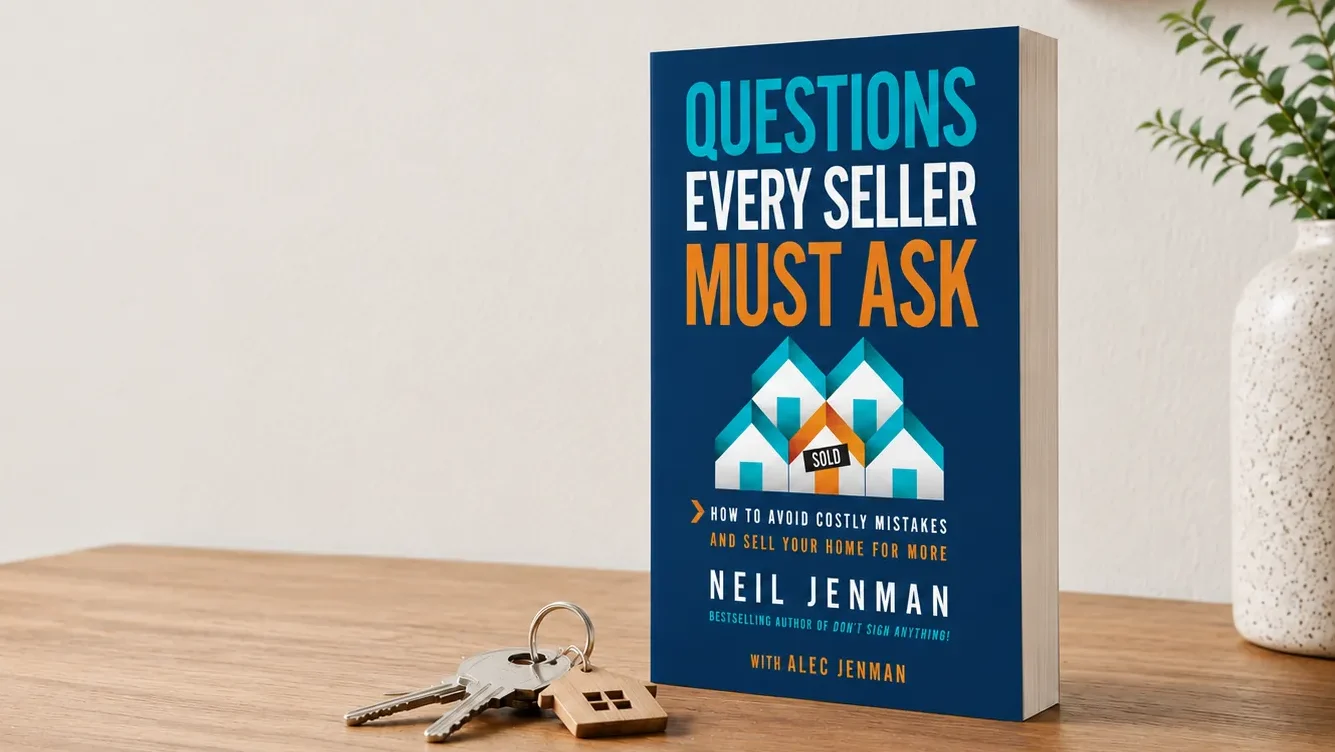
But not with truly honest, decent and caring agents. Those you’ve treated well. And often those who’ve done the same homework as you – such as reading Questions Every Seller Must Ask. Some agents, after reading this book, agree to place your interests first.
In case you’re wondering how you sell an agent to take the risk, it’s simple. You make it clear that the only way you will agree to hire an agent is if they offer you risk-free selling. No charges until sold. And watch how much harder they work for you when it’s their financial neck on the line. As is done in every other country in the world.
It’s called fairness. And your first job is to sell the agent on treating you fairly. If you want to take a shortcut, you can contact Jenman Support and ask us to suggest a possible agent.
We insist that all agents to whom we suggest for sellers have agreed to our eight seller protection points.
Stop focusing on how much the agent gets. Instead, focus on how much you get. If the agent gets you a great price, they may well deserve a good commission.
The most important factor with commission is justification. If an agent who charges 2.5% can sell a property for 10% more than an agent who charges 1.5%, the higher rate is more than justified. Also, if the 2.5% includes all costs and the agent is bearing all risks, the 2.5% could be better than an agent who charges 1.5% but adds-on needless marketing costs which are payable even if the agent fails to sell your property.
Always focus on the net price you receive. If that net price is not high enough, that’s the time to lowers the commission.
But do not make the mistake of pushing the agent down in their commission before they start working. Wait and see what sort of a job they do and then decide if they are worth the commission they request. Justification, remember.
If you push the agent down in commission before they start to work for you, you are taking away their incentive. This is especially dangerous in a tough market when buyers are scarce.
Imagine this: An agent has two homes for sale, both similar. On the first home, the owner has agreed to pay 2.5 per cent commission (if they are happy with their net price). On the second home, the owners have pushed the agent down to 1.5 per cent regardless of what price their home sells.
Which home is the agent more likely to push? Obviously the home with the better commission for the agent.
One of the most important points with commission – that many sellers fail to realise is this: Commission is negotiable until the time the property is legally sold.
Let the agent start off with the strong incentive that if they get you a high price you may consider a higher commission. So often, cheap agents mean cheap selling price. If an agent can’t negotiate a good commission for themselves, they are unlikely to negotiate a good price for your home.
And please – for the sake of fairness – if you want the agent to lower their commission, always ask before the sale is legally binding. To sign the sale contracts at an agreed price and commission and then, later, to try and push the commission lower is unfair.
Speaking of unfair, do not make the mistake of thinking that if an agent sells your home quickly, it means they should discount their commission. To sell a home for a high price in a short time, is often a sign of great skill and efficiency. You wouldn’t punish a doctor who cured you fast, so don’t punish an agent who gets you a great price in a short time.
Otherwise, here’s what’s likely to happen. If the agent gets a hint from you that you will be asking for a big discount if they sell your home fast, this will encourage them to do what many agents do. Hold the sale back.
So many agents rightly think that if they sell a home in a short period of time, the sellers will demand a discount. And so, the agents deliberately delay the sale. They may run up more costs. They will certainly take more time which usually costs the sellers dearly.
All because the agent was scared to say to the sellers, “I have done a great job by selling your home for a great price in a few days. So, of course, I deserve a great commission.”
One of the big mistakes in business and in life – not just in real estate – is mistaking activity for productivity.
Do not be a seller who complains that nothing is happening especially if the agent is in regular contact with you.
It’s common in the real estate industry to create lots of “noise” to make sellers think that activity means they are working hard. Maybe. But if they are making lots of noise – lots of advertising and open-for-inspections with neighbours and sticky-beaks – and the home is not selling, that’s worse than no noise and no sale.
When lots of people see a home – either at an open-house or in repetitive advertising – and the home remains unsold, people wonder what’s wrong with it.
Activity without a sale damages the value of a home. In the real estate industry, activity conditioning is a common way agents push sellers down in price. They tell them how many “views” they’ve had online – as if the more views without a sale means the price needs to be dropped. In such cases, the agent needs to be dropped.
A common plea in real estate offices is when a salesperson says to the other salespeople, “Please help me out. Take some buyers through XYZ Street so that I can convince the sellers to drop their price.”
And buyers, if you’re ever wondering why an agent is showing you a property – which is nothing like what you asked to buy – chances are that you are being used a stooge.
The agent who is most likely to sell you a home is the agent who is most enthusiastic about your home. Product belief is a great selling strategy. If the agent loves your home, chances are the buyers will love it too.
The buyers who are most likely to pay the best price for a home are those who fall in love with the home.
What do you love about your home?
Why did you select this home all those years ago?
Think about it.
And then prepare what’s known as ‘Love List’. Nobody – and certainly not the agent – knows your home as well as you. You need to get enthusiastic about your home if you want the agent to be enthusiastic.
Selling is often called the transference of enthusiasm. If you prepare a Love List and pass it to an agent with enthusiasm, the agent is more likely to pass it on to buyers with enthusiasm.
There is nothing more damaging to a sale than neglecting a fabulous selling point. That doesn’t mean, of course, that you castigate agents if they fail to mention something that you think is relevant or special. If buyers don’t like homes, there’s not much point telling them that the tiles on the bathroom wall were imported from Transylvania.
Most real estate advertisements are mind-numbingly dull – just basic bullet points.
But the biggest error with advertising is saying too much. This is because agents – often pushed by homeowners – include far too many features.
Advertising should have one purpose – to attract an enquiry that leads to an inspection and, therefore, a possible sale.
An advertisement is not meant to sell a property.
The best paying buyers insist on inspecting a property. But the more you tell them in an advertisement, the more likely they are to decide based purely on photographs. This is especially true with videos. You don’t want buyers to decide about your home based on a video. No matter how good the video, no matter how lovely the music, a video will struggle to convey the atmosphere of a home.
AIDA has been the selling formula for years: Attention, Interest, Desire, Action.
Another mistake is spending thousands of dollars to make your home look like a movie star’s mansion. The buyers love it online, but when they see reality, they feel cheated. Again, with photos, all you need is a small number – less than ten – which will be enough to attract interest. And create an enquiry.
As for drones, well, that’s another issue.
Most homes look worse from above, not better. And why have a photo of something that makes your home look worse? Or why have a photo of something that you will never see?
Unless the drone photo is going to attract enquiries that would not have otherwise happened, don’t use them.
And, if possible, when it comes to advertising, try to put some real heart into the advertisement. The best buyers are heart-buyers. And the best advertisements are those that appeal to the heart.
I once wrote an ad for a home that had been for sale for months. It was a beautiful home, but the ad was boring.
I added heart and love to it.
When the agent saw it, he said it was terrible. He said that he could not put his name on such an ad. He said it would damage his reputation. Meaning, of course, his ego.
The owners loved the ad, so they sacked the agent and found an agent who loved the ad. The home sold within a week. To a heart buyer. As the saying goes, “Home is where the heart is.”
Love is the greatest emotion in life. People often use the word love when referring to their homes. Yet agents are often reluctant to mention love.
Maybe, like the agent who said my ad was “terrible”, it doesn’t suit their image.
But it does suit the buyers.
It does sell homes.
FOOTNOTE: If you would like to see a copy of the agent’s original ad and the ad that he described as terrible which ultimately sold the property for a great price within a week, please contact [email protected]
Nothing kills an agent’s enthusiasm to sell a home faster than one of the sales crippling cliches commonly used by inexperienced or uneducated sellers.
Phrases like, “We are not in a hurry,” puncture an agent’s enthusiasm. Translated, the agent hears, “The sellers wants an unrealistically high price, and I have no chance of getting it.”
So why try?
Why indeed, especially if the sellers are expecting the agents to take the risks.
No agents with any business acumen are going to risk putting up thousands of dollars of their own money for a seller whose home is nearly impossible to sell.
Sellers who use the “not in a hurry” statement say it as if they are the only ones who’ve ever said. As if the agent should take note of the uniqueness of this statement.
But every agent hears that statement constantly.
Other comments such as “We are not going to give it away,” or “We are prepared to wait for our price,” are all a turn-off to agents.
They are also comments that, if true, are likely to cause a home to be on the market for many years.
No thanks.
If your home is like many homes in your area and you price it well above the price of comparable homes, all you’ll do is damage its value.
Granted, some agents may accept such homes – often to use these homes to demonstrate that other homes are good value.
Meanwhile, the overpriced home continues to do enormous damage to its value which is what happens to homes that sit on the market for many months.
If you’re seriously considering selling your home, don’t make the mistake of massively overpricing it, especially in a falling market.
There’s a truism in real estate: If you start too high, you’ll be forced to sell too low.
This is because, once a home is known as “over-priced” it soon carries the lemon tag.
Even if the owners then decide to place it at what should have been fair market price, it’ll be too late. Buyers will be house-shy of this house. The only way to get it sold is likely to be by massively dropping the price.
And that’s the price of massively over-pricing in the beginning.
Massively under-selling at the end.
The best way to get action on your home is to offer the agent a good incentive and then say these words, “We are serious sellers. Our home is going to be sold. And we will sell it to the buyers that offer us the best price in today’s market.”
Privately, of course, you will want to make sure that the best price you are offered is the best price the offering buyer is willing to pay.
This is why you must always insist on a Buyers’ Price Declaration.
Incredibly, some agents have never heard of this document. But that’s because some agents – thousands of them – have no negotiation training or skills.
If you have hired such an agent, it may be time to look for a better agent.
Sure, you need to be serious about selling. But you also need to be serious about making sure that when your property is sold, it is for the best price the buyer is prepared to pay.
A copy of the Buyers’ Price Declaration is on page 215 of the book, Questions Every Seller Must Ask. Copies are available in bookshops or online.
Consider these seven tips. Be sure you understand them. More importantly, of course, be sure that your agent understands them.
And that means you may need to “sell” the agent on how best to sell your house.
If you need help, you are welcome to contact [email protected]. We spend much of our working lives searching for the right agent for the right sellers.
And the right sellers are those who take the time to do some research to ensure that their greatest asset sells for the highest possible price.
In any market.
At any time.
******************
To comment on this article, please click here.
To contact us, please click here.
To follow Neil on Twitter, please click here.
To visit our Facebook page, please click here.
To read more Articles, please click here.
******************


Fred says:
Nice piece, Jenman-love your work