

by Neil Jenman
Reading time: apx 5 mins
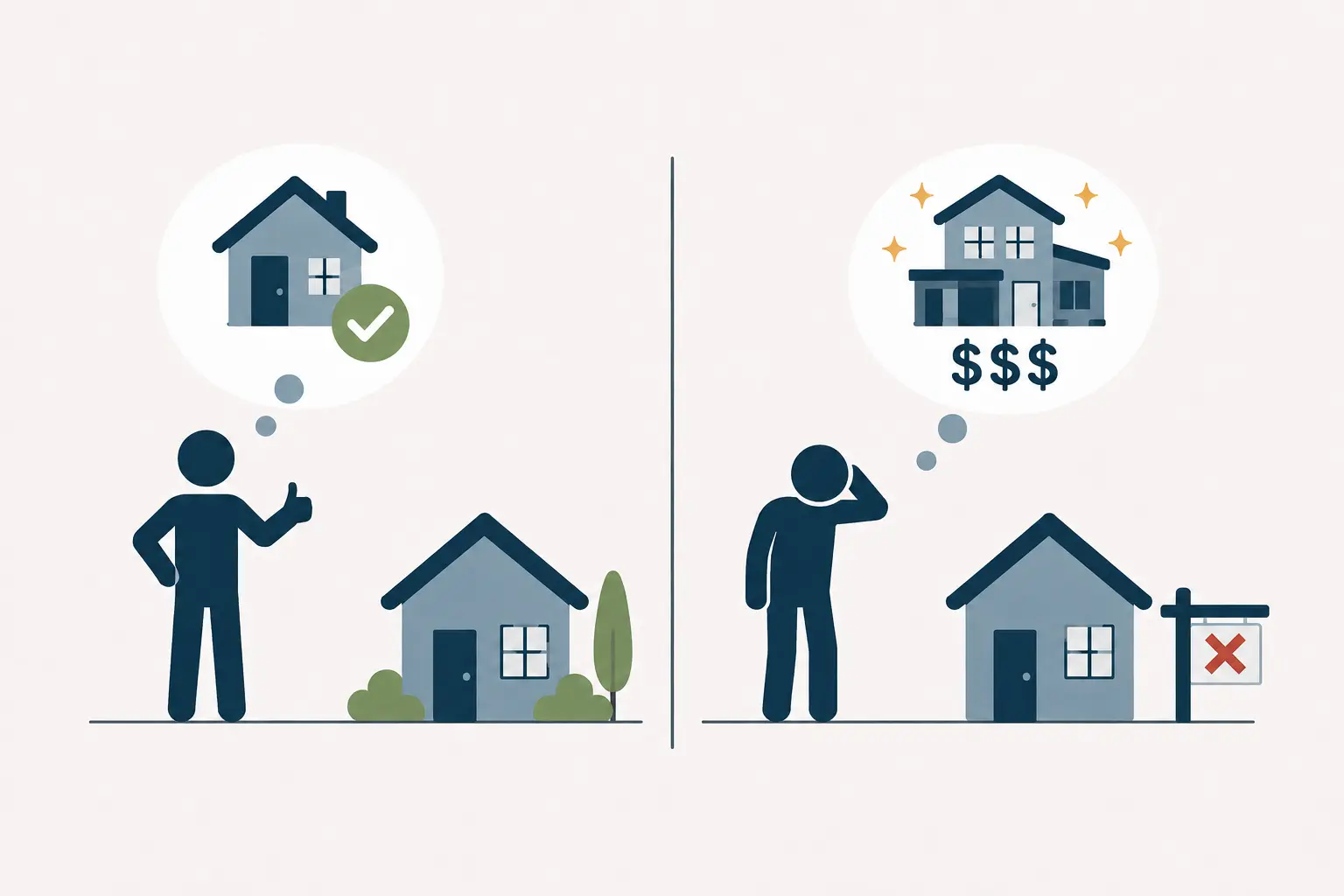
There is one sure way to know if a home for sale is over-priced. Nobody wants to buy it.
It doesn’t matter how much owners love a home – or how much they think it’s worth; it doesn’t matter how much the agent (or a valuer) quoted, if no one’s buying it, then it almost always means one thing – the price is too high.
And yet, despite this obvious fact, many home sellers stubbornly hang on. They refuse to sell unless they can get “their price”. They blame their agent, they blame the buyers, they blame the government, they even blame the season.
They rarely blame themselves.
This refusal to face a basic fact – that their property is over-priced – is one of the main reasons that sellers unknowingly do tremendous damage to the value of their homes.
You see, the longer a home stays for sale, the more buyers ask why it hasn’t sold.
And, unlike sellers, there are usually only two reasons in buyers’ minds for why a home remains unsold: Either something is seriously wrong with the home or it’s massively over-priced.
This causes buyers to do one of two things – either avoid the home or make an absurdly low offer for the home. Either way, sellers lose.
Those who eventually sell are often forced to accept a much lower price than if they’d priced their property more reasonably from the start.
Sellers who refuse to sell at today’s prices encounter a modern phenomenon that does huge damage to the value of their homes. It’s called the ‘digital footprint’.
Years ago – in the pre-internet days – homeowners could put their homes for sale and ask a dream price. Yes, one of those equivalent to winning Lotto prices. And then, when the agents and the buyers stopped laughing, the owners could quietly withdraw from sale. Within a few months, all would be forgotten. And forgiven. No one would be the wiser.
But not anymore. Not in the modern world.
These days, the moment your home is advertised online, it stays online – in one way or another.
Even if you withdraw from sale, your failed attempt to sell will be forever known. “Oh, they tried to sell that place once before and couldn’t sell it,” is what many buyers will think.
Once again, two thoughts will surface: Something’s wrong with this place or the owners are too greedy.
Greed is a word that you never want to have associated with your home sale.
There is nothing wrong with wanting the best price possible for your home.
This is especially true if it’s your much-loved family home (as opposed to, say, an investment property). If you’ve lived and loved in a family home for years, even decades, the emotional attachment is powerful.
There’s a psychological term for this. It’s called “the endowment effect”.
You probably don’t want to sell, but times and the ongoing years have made selling an unpleasant but essential prospect.
And so, by over-pricing your home, it fails to sell and you get to stay a little longer.
But then, of course, when time marches on and you find yourself compelled to sell, you get a lower price.
That’s when your fear of under-selling comes true.
By over-pricing at the start, sellers under-sell at the end.
But savvy sellers don’t fear under-selling their homes because they understand a vital factor of real estate negotiation. If you price your home too low, you’ll attract more than one buyer.
And if you should be fortunate to attract more than one buyer, you’ll start an ever-increasing-offer battle for your home.
This will guarantee that you sell for the highest possible price.
The subject of negotiation is not a required subject to obtain a real estate license. And, despite what they claim, most agents are not good negotiators. This is why so many homes are so massively under-sold with methods such as public auction.
The sure sign of an agent who doesn’t know how to negotiate is an agent who recommends a sale by public auction.
Other agents – usually the most unethical as well as the most incompetent – suggest, with a wink and a nod, that you engage in some form of bait pricing. This means offering a property for sale at a price you will never accept; but the agent says it will attract more buyers, and the agent can then talk them up.
As well as being illegal, this method is also incompetent because all it does is attract buyers who can’t afford to pay the price your property is worth.
The secret to success is to hire an agent who’s a competent negotiator and then to price your property fairly. Set a price that you will accept (but you hope to get more). In other words, you should start off asking a price which might be the worst you’re prepared to accept.
This way you are likely to attract several buyers.
And then, if your agent is a good negotiator, the agent will ask each buyer to make their offer in private – without other buyers knowing the amounts offered by each buyer.
This can drive the price of your home into the stratosphere.
It will certainly get you the very best price.
Too many sellers ask too high a price and then settle down for the long waiting game. This is the worst thing you can do to get the best price.
At some prices that some sellers are asking – especially in a falling market (which is now occurring in many areas) – it is no exaggeration to say that the buyers for their homes are yet to be conceived.
Seriously, how long are you prepared to wait for “the buyer who’ll pay our price”. A few months? A few years?
There are sellers whose homes have now been for sale for more than a year. In some cases, as long as three years.
How do you think the owners feel? Frustrated? Darned right. Jaded? Absolutely.
But it gets worse.
As well as being frustrated and upset, people who’ve had their homes on the market for lengthy periods of time – say more than three months – have almost certainly wiped thousands of dollars off the valley of their homes.
By keeping your home on the market too long and holding out for too high a price, you are leaving yourself with two choices: accept a much lower price or give up on selling.
The way to sell your home for the best price – especially in a declining or down market – is simple.
Gather as much knowledge as possible about the selling process.
Interview as many agents as it takes for you to find a competent negotiator.
Set a fair asking price which will attract buyers in the current market.
If you are fortunate to attract more than one buyer, you will likely sell above your expectations.
This is the opposite to what is happening to so many people who are currently holding out for too long and are ending up bitterly disappointed.
Do the right thing from the start. Price your property right.
And you’ll get the right price.
******************
To comment on this article, please click here.
To contact us, please click here.
To follow Neil on Twitter, please click here.
To visit our Facebook page, please click here.
To read more Articles, please click here.
******************